CEE
100
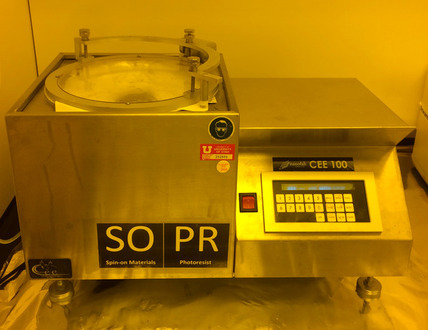
The CEE 100 is a programmable spin coater used for photoresist application in photolithography. The CEE 100 accepts wafers up to 6 inches in diameter and supports 10 programs with up to 10 steps each. The CEE 100 also exists in a spray developer configuration and a CEE 100CB spinner/hotplate variant.[1][2]
Wafer size
6"
Gas delivery
Spray Developer[2]
How it works
The CEE 100 accepts up to six-inch wafers. The CEE 100 supports programmable operation with ten programs, and each program can include up to ten steps including acceleration, speed, and time.[1]
What can it run?
Process applications and technology nodes documented for this tool.
- Photolithography
- Lift-off resist processing
What do the numbers mean?
Wafer handling2
Gas & chemistry1
Control & software1
Configuration & options5
Vintage & configurations
Documented models & variants
| Designation | Generation | Vintage | Changes | Source |
|---|---|---|---|---|
| CEE 100CB | — | — | Includes a hotplate; available in table top and bench mount configurations | nanofab.ece.cmu.edu[2] |
What replaced it?
What does it need to run?
Site utility requirements, footprint, and infrastructure needed to install and operate this tool. Sourced from public records.
- Tool typeSpray Developer[2]
Where are the manuals?
Generated from public-source data on file. Enter your email to access — nothing is published; details are routed privately.
Not publicly documented
Field notes
No research found yet — worked with this tool? Share what you know.
Frequently asked questions
What wafer size does the CEE 100 accept?
The CEE 100 accepts up to six-inch wafers.[1]
How many steps can each CEE 100 program include?
Each CEE 100 program can include up to ten steps.[1]
Which resist processes are linked to the CEE 100?
The CEE 100 is linked to AZ nLOF, LOR10B, Shipley 1813, and a standard process.[1]
Not publicly documented
The following facts about the 100 are absent from this record as of this revision. First-hand knowledge or a citation closes a gap; every submission is reviewed before publication.
No publicly documented production dates or lifecycle milestones (introduction, end of production, EOL) for the 100 are on record.
Answerable by: OEM historical records or a trade-press announcement
The control-system platform and OS era of the 100 are not on record.
Answerable by: an engineer who operated it or OEM installation records
No publicly documented failure modes or field errata for the 100 are on record.
Answerable by: a field service engineer, process engineer, or maintenance technician
The process node or technology generation of the 100 is not on record.
Answerable by: an OEM datasheet or a fab qualification report
No publicly documented compatible parts, consumables, or accessories for the 100 are on record.
Answerable by: an OEM parts catalog or a service engineer
No research found yet — worked with this tool? Share what you know.
Sources & citations
Sources (3)Every fact above is drawn from these public sources
- [1]nanofab.utah.edu — nanofab.utah.edunanofab.utah.edu
- [2]nanofab.ece.cmu.edu — nanofab.ece.cmu.edunanofab.ece.cmu.edu
- [3]Equipment Page | Utah Nanofab — nanofab.utah.edunanofab.utah.edu
Last updated Oct 3, 2026.
Compare with similar tools
View all →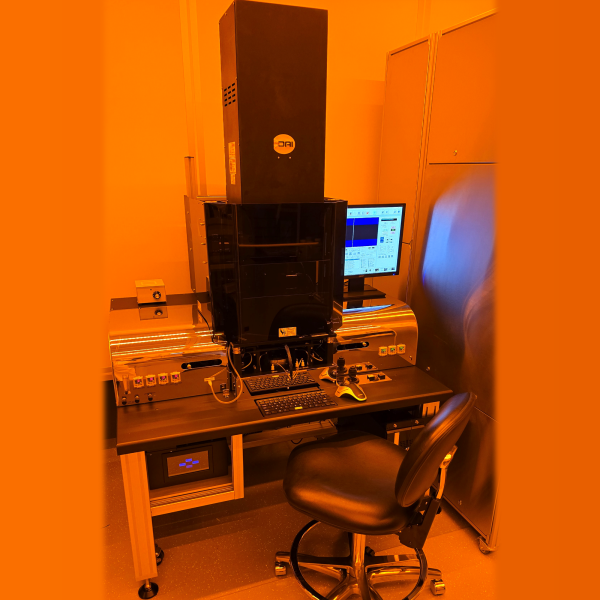
The OAI 806 Mask Aligner is a precision photolithography tool for patterning substrates up to 6 inches with soft, hard, and proximity contact modes.

Heidelberg Instruments DWL66 is a high-resolution direct write pattern generator for direct writing on various substrates and mask making.
Raith EBPG5200 is a direct write electron beam lithography system with high-kV capability and automation features stated in the product page for the EBPG line.
